Introduction🌿
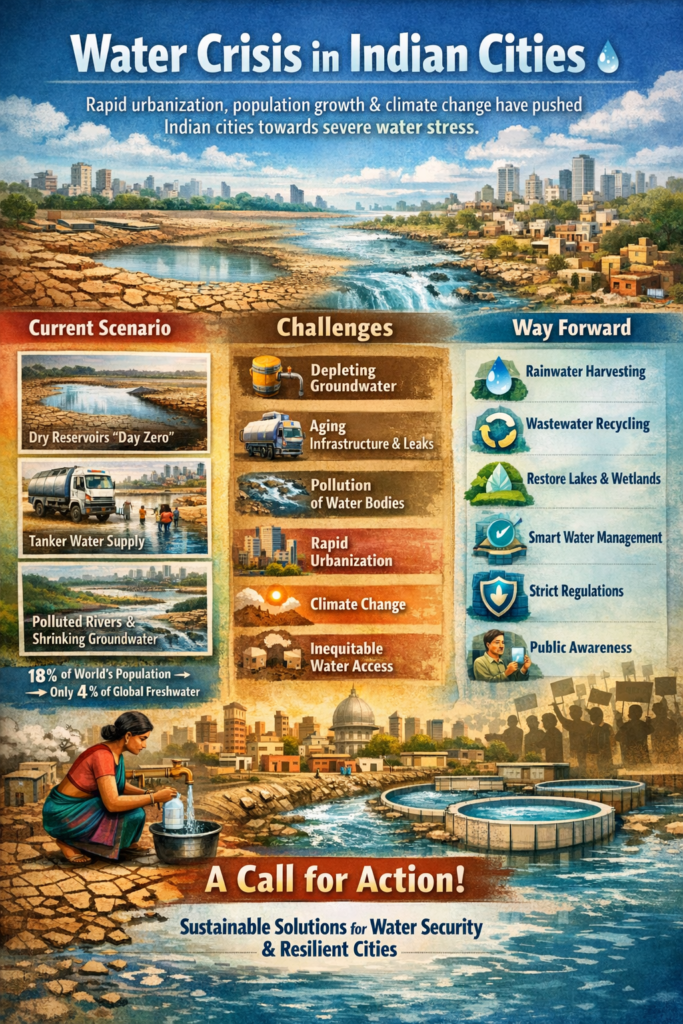
Water is the foundation of life, economic growth, and public health. However, rapid urbanization, population growth, and climate change have pushed many Indian cities toward severe water stress. India holds nearly 18% of the world’s population but only about 4% of global freshwater resources, making sustainable water management a critical challenge.
The urban water crisis today is not just about scarcity, but also about poor management, inequitable distribution, and declining water quality.
Current Scenario🌿
Several Indian cities are facing alarming levels of groundwater depletion and supply shortages. Cities like Chennai have experienced “Day Zero”-like situations, where major reservoirs dried up due to weak monsoons and over-extraction. Bengaluru faces rapid groundwater depletion due to unregulated borewells and shrinking lakes, while Delhi struggles with unequal water distribution and pollution of the Yamuna River.
According to government reports, a significant proportion of urban households depend on tanker water or private borewells. Water supply in many cities remains intermittent, often available only for a few hours a day, highlighting the structural weaknesses in urban water systems.
Challenges❌
1. Over-Extraction of Groundwater – Excessive drilling of borewells without regulation has led to falling water tables in metropolitan areas.
2. Poor Infrastructure and Leakages – Aging pipelines cause massive water losses through leakage and theft.
3. Urbanization and Encroachment – Lakes, wetlands, and recharge zones are shrinking due to construction and real estate expansion.
4. Pollution of Water Bodies – Untreated sewage and industrial waste contaminate rivers and lakes, reducing usable freshwater.
5. Climate Variability – Erratic monsoons and extreme weather events disrupt water availability.
6. Inequitable Distribution – Slums and informal settlements often receive limited or no piped water supply.
Way Forward✅
1. Rainwater Harvesting
Mandatory rooftop rainwater harvesting in urban buildings to recharge groundwater.
2. Wastewater Recycling
Treating and reusing wastewater for industrial and non-potable purposes.
3. Revival of Urban Water Bodies
Restoring lakes, wetlands, and traditional water systems.
4. Smart Water Management
Use of digital monitoring, smart meters, and GIS-based mapping to detect leaks and manage supply efficiently.
5. Policy and Regulation
Strict regulation of groundwater extraction and better implementation of water conservation laws.
6. Public Awareness
Encouraging responsible water use through community participation and behavioral change.
Conclusion
The water crisis in Indian cities is a pressing and multidimensional issue. Without immediate and coordinated action, it may threaten public health, economic stability, and social harmony. Sustainable urban planning, technological innovation, strong governance, and citizen responsibility are essential to ensure water security for future generations.