Introduction:
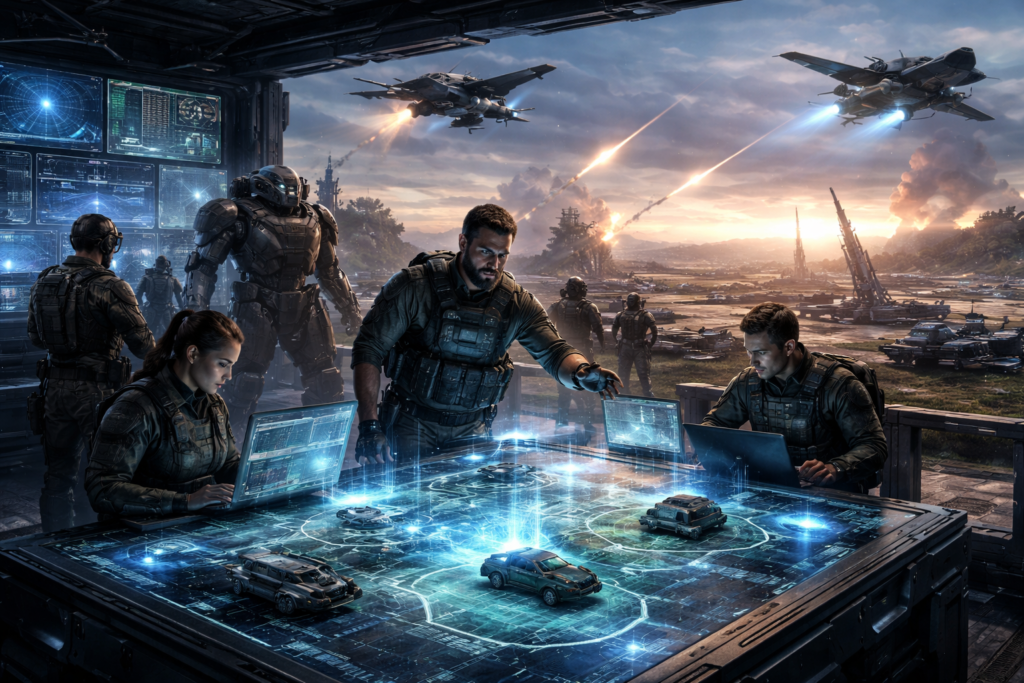
Artificial Intelligence (AI) refers to machines performing tasks that normally require human intelligence, such as learning, reasoning, and decision-making. In defence, AI is transforming warfare from manpower-intensive to technology-driven and information-centric warfare, where speed, precision, and data dominance are key.
Current Scenario:
Globally, AI has become a core component of modern military strategy:
• Autonomous weapons systems like drones, loitering munitions (e.g., seen in Ukraine conflict)
• Swarm technology, where multiple drones coordinate attacks
• AI in intelligence gathering, satellite imagery analysis, facial recognition
• Predictive maintenance of military equipment
• Cyber warfare and electronic warfare systems
In India:
• Defence AI Council (DAIC) and Defence AI Project Agency (DAIPA)
• iDEX initiative promoting startups
• AI integration in border surveillance, drone systems, and logistics
Challenges & Concerns
1. Ethical and Moral Dilemma:
• Lethal Autonomous Weapon Systems (LAWS) can take life-and-death decisions without human intervention
• Accountability issue: Who is responsible if AI makes a wrong decision?
2. Lack of Human Judgment:
• AI lacks emotions, intuition, and context understanding
• Battlefield situations often require ethical reasoning, not just data processing
3. Cybersecurity Risks:
• AI systems are vulnerable to hacking, data poisoning, and adversarial attacks
• Enemy can manipulate AI decisions → turning your own system against you
4. Data Dependency & Bias:
• AI depends on large datasets; biased or incomplete data can lead to wrong targeting or flawed analysis
5. High Cost and Resource Intensive:
• Requires advanced infrastructure, computing power, and skilled workforce
• Developing countries may lag behind → widening defence gap
6. Technological Dependence:
• Over-reliance on AI can reduce human skills and decision-making ability
• System failure in critical situations can be disastrous
7. AI Arms Race & Global Instability:
• Nations competing for AI supremacy → similar to nuclear arms race
• Can lower the threshold for war due to reduced human risk
8. Legal and Regulatory Gaps:
• No clear international laws governing AI warfare
• Geneva Conventions are not fully equipped for autonomous weapons
9. Unpredictability of AI Systems:
• AI may behave unexpectedly in complex battlefield scenarios
• Lack of transparency (“black box problem”) makes decisions hard to interpret
10. Job Displacement in Armed Forces:
• Automation may reduce the role of soldiers in certain operations
• Raises concerns about restructuring military roles
Way Forward:
• Ensure Human-in-the-Loop for critical combat decisions
• Develop robust cybersecurity frameworks
• Promote indigenous AI development (Atmanirbhar Bharat)
• Establish global regulations and ethical standards
• Invest in training and upskilling defence personnel
• Encourage civil-military collaboration and startups