1️⃣ Introduction
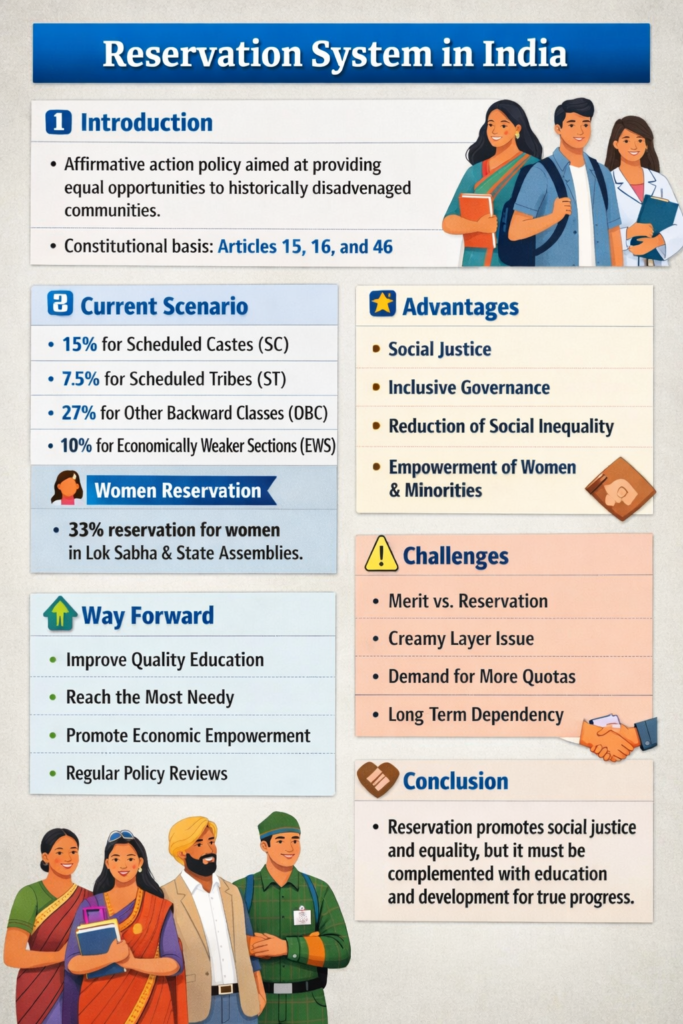
The reservation system in India is a policy of affirmative action designed to provide equal opportunities to historically disadvantaged communities. It aims to address centuries of social discrimination, caste hierarchy, and lack of representation in education, jobs, and politics.
The foundation of reservation comes from the Constitution of India, particularly Articles 15, 16, and 46, which empower the government to make special provisions for socially and educationally backward classes.
2️⃣ Current Scenario
In India, reservations exist mainly in education, government jobs, and political representation.
At the central level:
• 15% reservation for Scheduled Castes (SC)
• 7.5% reservation for Scheduled Tribes (ST)
• 27% reservation for Other Backward Classes (OBC)
In 2019, the government introduced 10% reservation for Economically Weaker Sections (EWS)through the 103rd Constitutional Amendment of India.
Recent Development – Women Reservation
A historic step was taken in 2023 when Parliament passed the Nari Shakti Vandan Adhiniyam, also known as the Women’s Reservation Bill.
• It provides 33% reservation for women in the Lok Sabha and State Legislative Assemblies.
• The bill was passed with a large majority in Parliament and aims to increase women’s participation in politics.
• The reservation will come into effect after the next census and delimitation process.
• It will remain in force for 15 years initially.
This step is expected to significantly increase the number of women MPs, as currently women make up less than 15% of the Lok Sabha members.
3️⃣ Advantages of the Reservation System
1. Social Justice
It helps historically marginalized communities gain equal access to opportunities.
2. Inclusive Governance
Reservation ensures representation of diverse communities in government institutions.
3. Reduction of Social Inequality
It works as a tool to bridge the gap created by historical discrimination.
4. Empowerment of Women and Minorities
Policies like the women’s reservation bill promote gender equality and political participation.
4️⃣ Challenges and Criticism
1. Debate between Merit and Reservation
Some people argue that excessive reservation may affect merit-based selection.
2. Creamy Layer Issue
The benefits of reservation may sometimes be taken repeatedly by the economically stronger sections within reserved categories.
3. Political Demands for More Quotas
Many communities demand inclusion in reservation categories, leading to social and political tensions.
4. Long-Term Dependency
Critics argue that reservation should not become a permanent solution.
5️⃣ Way Forward
• Improve quality education and skill development at the grassroots level.
• Ensure benefits reach the most deserving sections of society.
• Promote economic empowerment along with social justice.
• Regularly review reservation policies based on changing social conditions.
6️⃣ Conclusion
The reservation system has played a significant role in promoting social justice, equality, and representation in India. However, for long-term progress, it must be complemented with education, economic development, and social reform so that every citizen can compete on equal footing.