
Quotation
“The greatest threat to our planet is the belief that someone else will save it.” — Robert Swan
Introduction
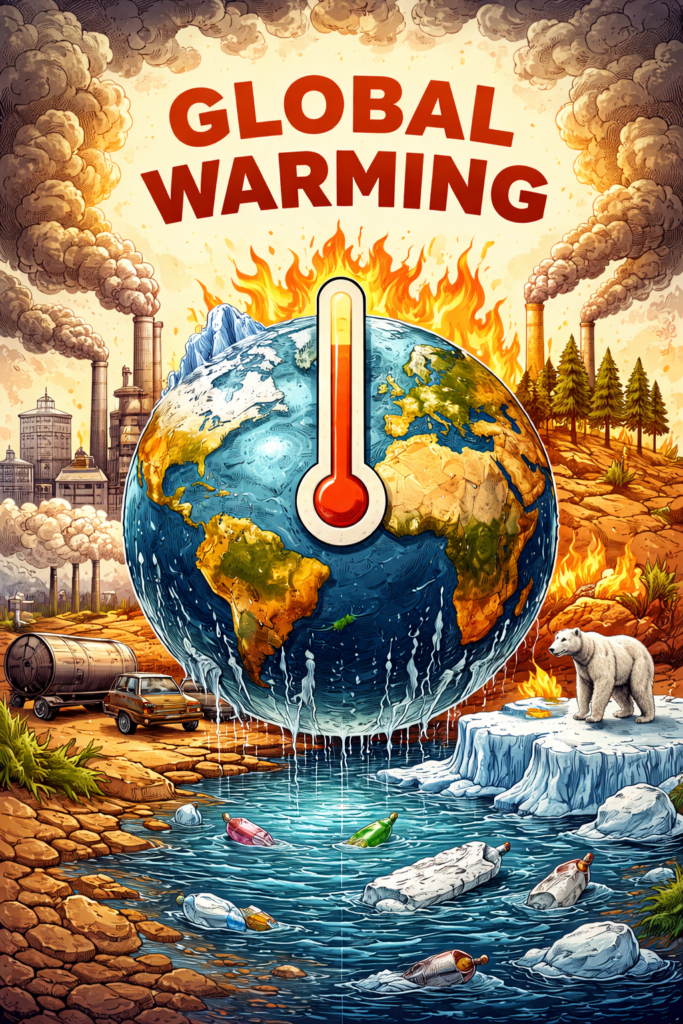
Global warming refers to the long-term rise in the Earth’s average surface temperature, primarily due to the accumulation of greenhouse gases such as carbon dioxide, methane, and nitrous oxide in the atmosphere. These gases trap heat and disturb the natural climate balance.
The phenomenon is largely a result of anthropogenic activities like industrialization, deforestation, and excessive dependence on fossil fuels.
Current Scenario
Global warming has now evolved into a global climate crisis with far-reaching consequences.
• The global temperature has already risen by approximately 1.1°C since pre-industrial times.
• The past decade has been the warmest on record globally.
• Glaciers in the Himalayas and polar regions are melting at an accelerated rate, contributing to rising sea levels.
• Extreme weather events such as heatwaves, cyclones, floods, and droughts are increasing in frequency and intensity.
• India is witnessing erratic monsoons, water scarcity, and agricultural stress.
• Coastal cities face the risk of submergence due to sea-level rise.
• International frameworks like the Paris Agreement and COP summits aim to control emissions, but implementation gaps remain.
Challenges
1. High dependence on fossil fuels for energy, transport, and industry
2. Rapid population growth, increasing pressure on natural resources
3. Deforestation and land degradation, reducing carbon sinks
4. Unplanned urbanization, leading to pollution and heat islands
5. Industrial emissions and vehicular pollution
6. Lack of strict enforcement of environmental laws
7. Economic priorities over environmental concerns, especially in developing countries
8. Limited awareness and behavioral resistance among the public
9. Global inequality, where developing nations demand climate justice
10. Technological and financial constraints in adopting green alternatives
Way Forward
1. Transition to renewable energy sources such as solar, wind, and hydro power
2. Promote energy efficiency and conservation practices
3. Large-scale afforestation and reforestation programs
4. Adoption of sustainable agricultural practices like organic farming and water management
5. Development and use of electric vehicles and clean transportation systems
6. Strengthening climate policies and strict implementation
7. Enhancing international cooperation and climate financing
8. Encouraging public awareness and lifestyle changes such as reducing carbon footprint
9. Use of modern technologies like AI, IoT, and data analytics for climate monitoring and prediction
10. Promoting circular economy and waste management systems