G7 Summit 2026
1. Introduction & Brief History
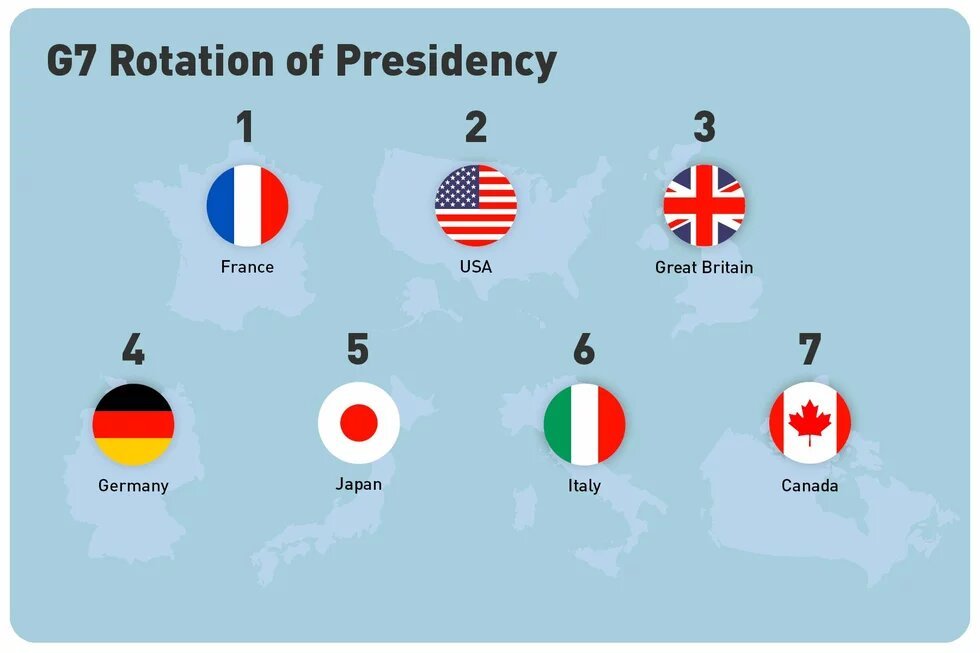
The G7 (Group of Seven) is an informal grouping of Canada, France, Germany, Italy, Japan, the United Kingdom, and the United States, along with the European Union.
It was formed in 1975 at Rambouillet, France as the G6 in response to the 1973 oil crisis and global recession.
Canada joined in 1976, making it the G7.
Russia joined in 1998 (G8) but was suspended in 2014 after the annexation of Crimea.
Important Facts:
G7 countries account for approximately 29–30% of global GDP.
They represent only about 10% of the world’s population.
The combined population is around 780 million people.
The G7 accounts for nearly 50% of global financial wealth and a significant share of global innovation and technology patents.
2. G7 Summit 2026: France
The 52nd G7 Summit was hosted by France at Évian-les-Bains from 15–17 June 2026.
Major Themes:
Russia–Ukraine conflict
Global economic slowdown
Artificial Intelligence governance
Climate change and energy transition
Critical minerals and supply chains
Food and energy security
Key Outcomes:
Continued support for Ukraine.
Discussions on AI regulations and responsible AI.
Strengthening critical mineral partnerships.
Emphasis on resilient supply chains.
Cooperation on clean energy technologies.
Data:
Global growth forecast for 2026 is around 2.8–3%.
Over 70% of advanced semiconductor production is concentrated among G7 partners and allies.
Clean energy investments worldwide crossed $2 trillion annually.
AI could contribute approximately $15 trillion to the global economy by 2030.
3. India’s Stand
Although India is not a member, it has become a regular invitee because of its increasing global importance.
India’s Significance:
5th largest economy with GDP around $4 trillion.
Contributes nearly 17–18% of the world’s population.
Fastest-growing major economy with growth rates above 6%.
World’s largest democracy.
India’s Position:
1. Voice of Global South
India advocates:
Climate justice
Food security
Development financing
Technology access
2. Reformed Multilateralism
India demands reforms in:
UN Security Council
IMF
World Bank
WTO
3. Climate Leadership
Target of Net Zero by 2070.
Aim of 500 GW non-fossil energy capacity.
One of the world’s largest renewable energy markets.
4. Strategic Autonomy
India maintains an independent foreign policy while promoting peace and diplomacy.
4. Challenges
A. Declining Global Share
In 1990, G7 economies contributed over 50% of world GDP.
Today, their share has fallen to approximately 30%.
B. Rise of Emerging Economies
BRICS countries now account for around 35–37% of global GDP (PPP basis).
India and China are becoming major growth engines.
C. Russia–Ukraine War
Food prices increased significantly after the conflict.
Energy prices witnessed major fluctuations.
Global supply chains were disrupted.
D. Internal Differences
Disagreements exist regarding:
China policy
Trade protectionism
Climate targets
Defense spending
E. Climate Challenge
G7 countries contribute around 20–25% of historical carbon emissions.
Yet developing countries demand greater climate finance.
F. AI Governance
Risks include cyber threats, misinformation, data privacy, and job displacement.
The IMF estimates that AI may affect nearly 40% of global jobs.
5. Way Forward
1. Greater Inclusion
Increase cooperation with India, Brazil, South Africa, and ASEAN nations.
2. G7-G20 Coordination
Since the G20 represents about:
85% of global GDP
75% of global trade
Two-thirds of the world’s population
Cooperation between G7 and G20 is essential.
3. Reform Global Institutions
Expand the UNSC.
Give larger representation to developing nations.
4. Climate Finance
Developed countries should fulfill the $100 billion annual climate finance commitment and increase green technology transfers.
5. Responsible AI Governance
Develop common AI standards.
Promote cybersecurity cooperation.
Ensure ethical use of emerging technologies.