
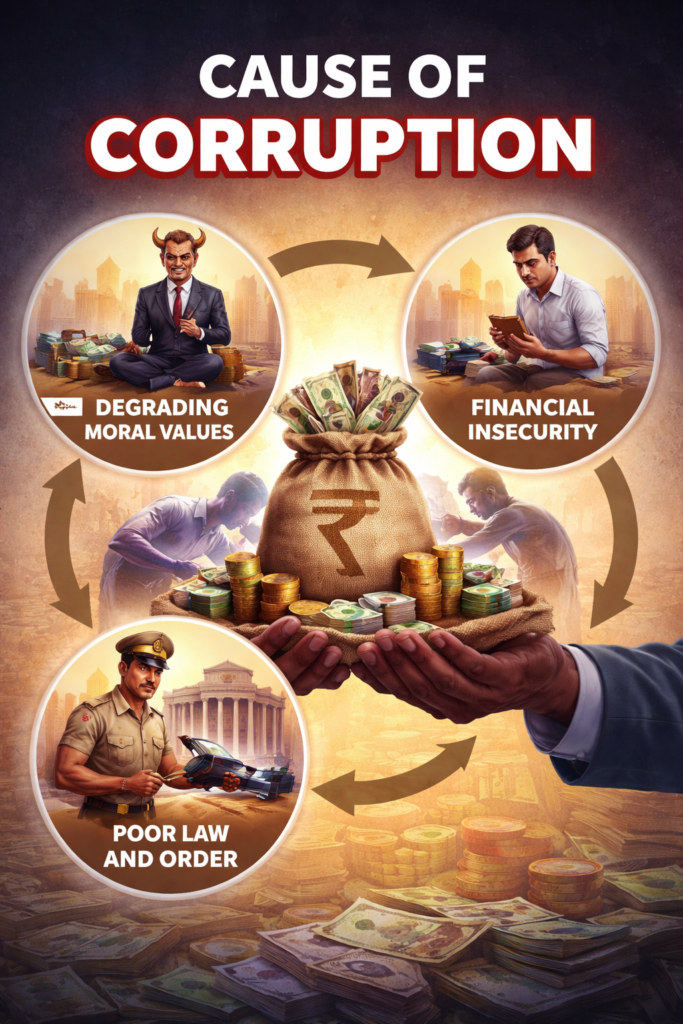
India is getting known for being one of the most corrupt nations. What
do you think is the main reason for corruption?
(a) Degrading moral values
(b) Financial insecurity
(c) Poor law and order
Although India has strong democratic institutions, corruption still remains a serious challenge affecting governance, development, and public trust.
A global indicator like the Transparency International Corruption Perception Index has often placed India in the middle range among countries, indicating that corruption continues to be a governance concern.
(a) Degrading Moral Values
One major reason for corruption is the decline in ethical and moral standards in public and private life.
• Many individuals prioritize personal gain over public duty.
• When honesty and integrity are not strongly valued in society, corruption becomes normalized.
• In some cases, people justify bribery as a shortcut to get work done faster.
Example:
Bribes in areas like driving licenses, construction approvals, or local administrative work often happen because both sides accept it as a normal practice.
Impact:
Such normalization gradually weakens institutional integrity and public trust.
(b) Financial Insecurity
Another reason is financial insecurity or economic pressure.
• Lower salaries in some sectors may push officials to seek extra income through illegal means.
• Rising cost of living and social pressure to maintain a certain lifestyle can also contribute.
For instance, before major pay reforms like the 7th Central Pay Commission, government employees often complained that wages were not keeping pace with inflation.
However, financial insecurity cannot fully justify corruption, because corruption is also seen among high-income officials and corporate leaders.
(c) Poor Law and Order
Weak enforcement of laws is another important factor.
• When punishment is slow or uncertain, people feel they can escape consequences.
• Investigations and court cases often take years to complete.
India has institutions like the Central Bureau of Investigation, Central Vigilance Commission, and Lokpal of India to tackle corruption, but delays in prosecution sometimes reduce deterrence.
Example:
High-profile corruption cases can take many years to reach a final verdict, which weakens the fear of punishment.