Introduction
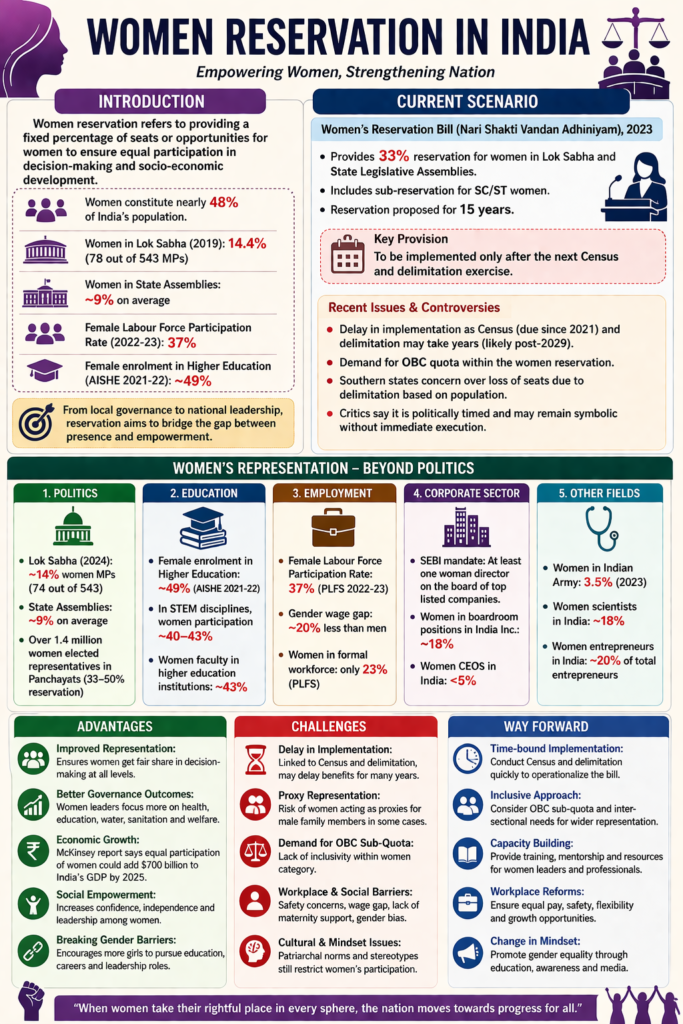
- Women reservation refers to providing a fixed percentage of seats or opportunities to women to ensure equal participation in decision-making and development.
- Women constitute nearly 48% of India’s population, yet their representation in leadership roles remains limited.
- In the Lok Sabha, women’s representation is around 14%, and in State Assemblies, it is only about 9% on average.
- Globally, India ranks around 140th in women’s parliamentary representation, which highlights a significant gap.
- However, at the grassroots level, reservation in Panchayats has led to over 1.4 million elected women representatives, showing positive results.
Current Scenario (Women’s Reservation Bill and Broader Context)
Political Reservation
- The Nari Shakti Vandan Adhiniyam, 2023 provides for 33% reservation for women in the Lok Sabha and State Legislative Assemblies.
- The bill also includes sub-reservation for women belonging to SC and ST categories.
- This reservation is proposed to be in effect for a period of 15 years.
Key Issue and Controversy
- The implementation of the bill is dependent on the next Census and delimitation exercise, which has led to concerns about delay.
- Since the Census has been pending since 2021, the actual implementation may happen only after 2029 or later.
- There is also a demand from several political groups for an OBC sub-quota within the women’s reservation, which is currently not included.
- The linkage with delimitation has created concerns, especially among southern states, regarding possible loss of political representation.
Women’s Representation in Other Fields
Education
- Women’s enrolment in higher education has reached around 49%, indicating near parity with men.
- In STEM fields, women’s participation is around 40–43%, but their presence declines at higher research and leadership levels.
Employment
- The female labour force participation rate is about 37%, which is still lower compared to global standards.
- There exists a gender wage gap of around 20%, with women earning less than men on average.
- Women’s participation in the formal workforce remains limited.
Corporate Sector
- As per SEBI regulations, top listed companies must have at least one woman director on their boards.
- However, women hold less than 20% of senior management positions, and the number of women CEOs in India is less than 5%.
Public Services and Other Areas
- Women constitute only about 3–4% in the armed forces, and around 11% in police forces.
- Women entrepreneurs account for roughly 20% of total entrepreneurs in India.
Advantages
- Women reservation helps in ensuring greater and fair representation of women in decision-making bodies across sectors.
- It leads to better governance outcomes, as women leaders tend to focus more on social sectors like health, education, and welfare.
- It contributes to economic growth, as studies suggest that equal participation of women could add nearly $700 billion to India’s GDP.
- It promotes social empowerment by increasing confidence, independence, and participation of women in public life.
- It helps in breaking traditional and patriarchal barriers, encouraging more women to pursue leadership roles.
Challenges
- The implementation of political reservation is likely to be delayed due to its linkage with Census and delimitation.
- There is a concern of proxy representation, where women may not exercise independent decision-making power in some cases.
- The benefits of reservation are often uneven, with urban and educated women gaining more than rural and marginalized women.
- Women continue to face workplace challenges such as safety concerns, lack of maternity support, and gender bias.
- Deep-rooted patriarchal attitudes and social norms still restrict women’s full participation in many sectors.
Way Forward
- There is a need for time-bound implementation of the Women’s Reservation Bill by expediting the Census and delimitation process.
- Policymakers should consider an inclusive approach by addressing demands such as OBC sub-quota.
- Efforts must be made towards capacity building by providing training and leadership development opportunities for women.
- Workplace reforms are required to ensure equal pay, safe working conditions, and better support systems for women.
- A long-term change requires shifting societal mindset through education, awareness, and promotion of gender equality.