
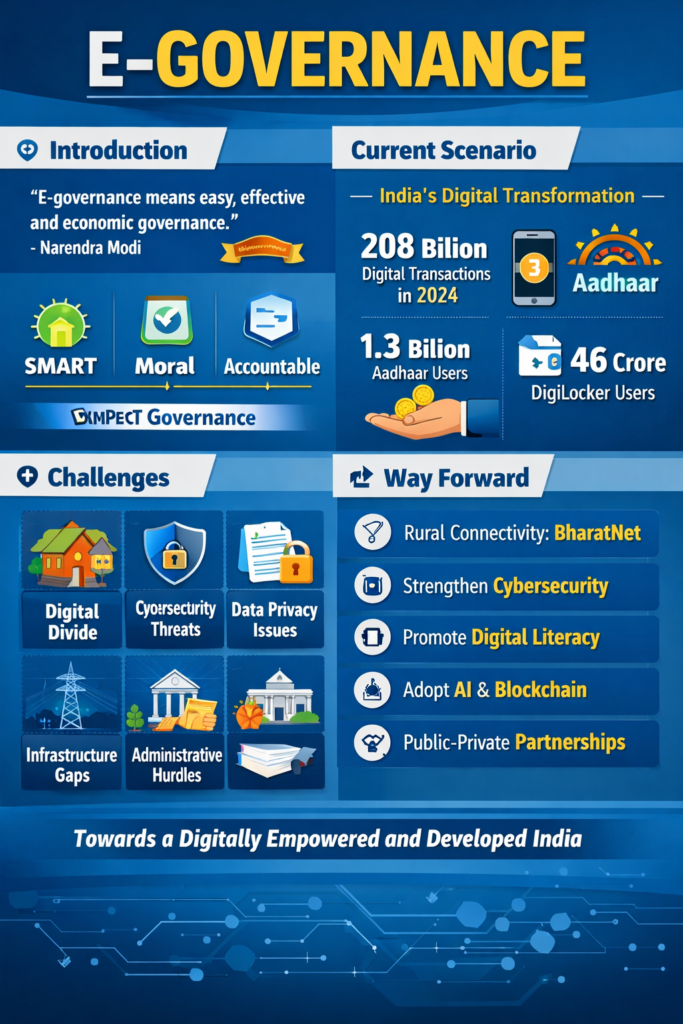
1️⃣ Introduction
E-Governance refers to the use of Information and Communication Technology (ICT) by the government to provide services, share information, and interact with citizens, businesses, and other government departments.
Its aim is to make governance SMART — Simple, Moral, Accountable, Responsive, and Transparent.
In the digital era, e-governance is becoming the backbone of efficient and citizen-centric administration.
2️⃣ Current Scenario in India
India has made remarkable progress in digital governance through initiatives like Digital India, launched in 2015.
Key Data and Achievements
1. Digital Payments Revolution
• India recorded over 208 billion digital payment transactions in 2024.
• Unified Payments Interface (UPI) accounts for about 83–84% of digital payment transactions in India.
• In FY 2024–25 alone, UPI handled about 185 billion transactions worth ₹261 lakh crore.
2. Digital Identity
• Aadhaar has over 1.3 billion enrollments, covering almost the entire adult population of India.
3. Digital Governance Platforms
• DigiLocker has 46+ crore users, enabling citizens to store and access digital documents.
• UMANG app provides 2000+ government services and has recorded over 516 crore transactions.
4. Digital Public Infrastructure
India’s Jan Dhan–Aadhaar–Mobile (JAM) Trinity has enabled Direct Benefit Transfers (DBT) worth over ₹14 lakh crore, reducing corruption and leakages.
5. Global Leadership
India today accounts for almost half of global real-time digital payment transactions, showing the strength of its digital governance ecosystem.
These achievements show that India is emerging as a global leader in digital public infrastructure.
3️⃣ Challenges
Despite significant progress, several challenges remain.
1. Digital Divide
Internet access and digital literacy are still limited in many rural areas.
2. Cybersecurity Threats
Increasing digitalization increases risks of cyber attacks, fraud, and data breaches.
3. Data Privacy Issues
Large databases like Aadhaar raise concerns about data protection and privacy.
4. Infrastructure Problems
Poor internet connectivity and power supply affect rural digital services.
5. Administrative Resistance
Some government departments still rely on traditional bureaucratic processes.
4️⃣ Way Forward
1. Expand high-speed internet in rural areas through BharatNet.
To strengthen e-governance, India should take the following steps:
2. Strengthen cybersecurity frameworks and data protection laws.
3. Improve digital literacy programs, especially for rural citizens.
4. Use emerging technologies such as Artificial Intelligence, Blockchain, and Big Data in governance.
5. Promote public-private partnerships to innovate digital solutions.