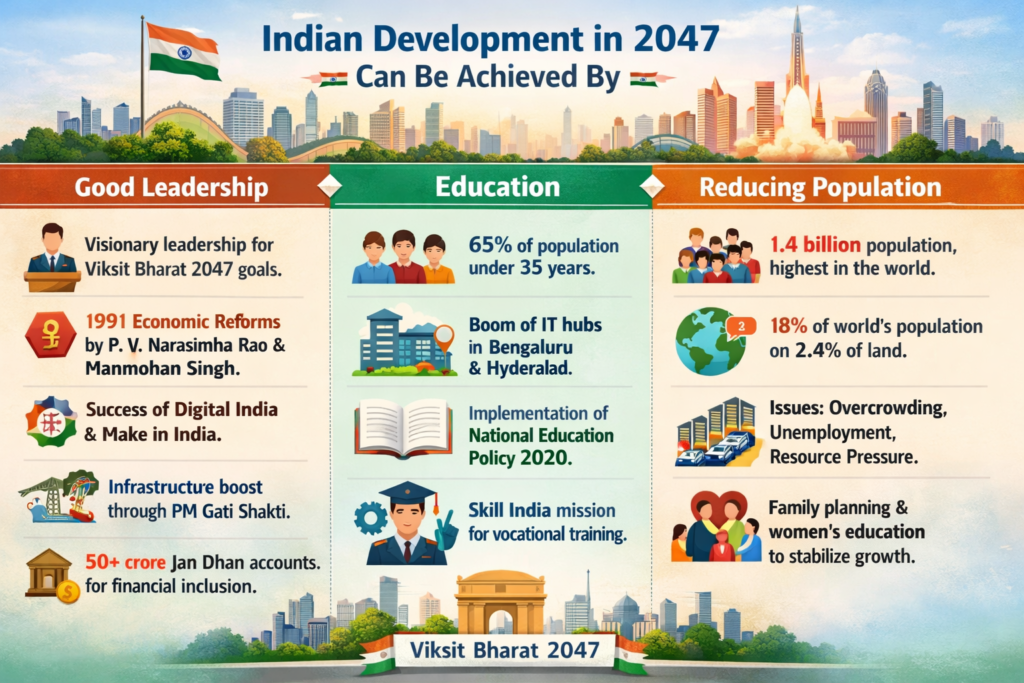
Indian development in 2047 can be achieved by
1- Good Leadership
2- Education
3- Reducing Population
Good Leadership
1. Visionary leadership helps in creating long-term national policies and development strategies. India’s vision of Viksit Bharat 2047 requires consistent governance and policy continuity for the next two decades.
2. The 1991 Economic Reforms led by P. V. Narasimha Rao and Manmohan Singhliberalized the Indian economy, resulting in higher GDP growth, increased foreign investment, and expansion of the private sector.
3. Effective leadership ensures the successful implementation of national programs like Digital India and Make in India, which aim to boost digital governance, innovation, and manufacturing capabilities.
4. Leadership also strengthens infrastructure development through initiatives such as PM Gati Shakti, which integrates transport networks like railways, highways, and ports to improve logistics efficiency.
5. Strong governance has improved financial inclusion through Pradhan Mantri Jan Dhan Yojana, under which more than 50 crore bank accounts have been opened for citizens.
Education
1. Education improves human capital and productivity, which directly contributes to economic growth and technological advancement.
2. Nearly 65% of India’s population is below the age of 35, providing a large workforce that can drive economic growth if properly educated and skilled.
3. India’s technology sector developed due to strong technical education. Cities like Bengaluru and Hyderabad have become major IT hubs with thousands of technology companies and startups.
4. The National Education Policy 2020 focuses on multidisciplinary learning, digital education, and skill-based training to prepare students for modern industries.
5. Government initiatives like Skill India aim to train millions of youth in vocational and technical skills, improving employability and entrepreneurship.
Reducing Population
1. India’s population is around 1.4 billion, making it the most populous country in the world and creating pressure on resources and infrastructure.
2. India holds about 18% of the world’s population but only 2.4% of global land area, which increases pressure on land, water, housing, and food resources.
3. Rapid population growth contributes to challenges such as unemployment, poverty, and stress on public services like healthcare and education.
4. Highly populated cities such as Delhi and Mumbai face overcrowding, traffic congestion, housing shortages, and pollution due to high population density.
5. Promoting family planning, improving healthcare facilities, and increasing women’s education can help stabilize population growth and improve overall living standards.