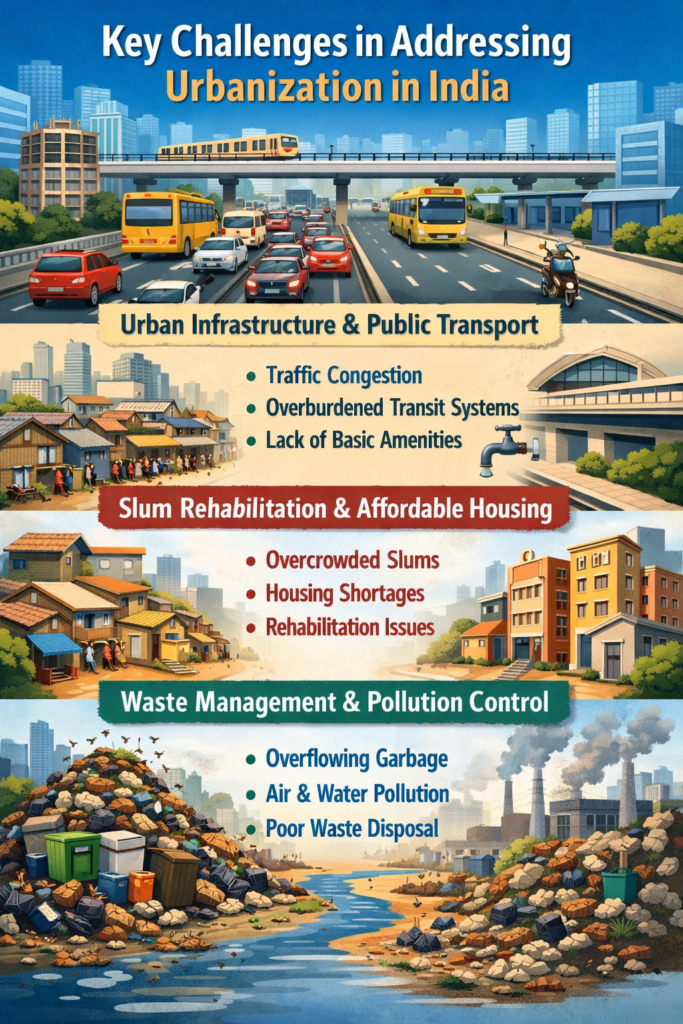
What are the key challenges in addressing urbanization in India
1)Urban Infrastructure Development and Public Transport
2)Slum Rehabilitation and Affordable Housing
3)Waste Management and Pollution Control in Urban Centers
1. Urban Infrastructure Development and Public Transport
Explanation
Urban infrastructure has not kept pace with population growth. Cities face stress on transport, water supply, drainage, electricity, and digital infrastructure, leading to inefficiency and reduced quality of life.
Key Challenges
• Traffic congestion and urban mobility crisis due to rapid increase in private vehicles
• Inadequate public transport coverage in tier-2 and tier-3 cities
• Water scarcity and poor distribution systems, with high leakage losses (non-revenue water)
• Sewage and drainage issues, leading to urban flooding during monsoons
• Urban sprawl, increasing travel time and infrastructure costs
• Lack of integrated urban planning and coordination among agencies
• Insufficient focus on sustainable transport (cycling, walking infrastructure)
Facts and Data
• Indian cities lose billions annually due to traffic delays and fuel wastage
• In many cities, over 50% of households lack piped water supply
• Nearly 70% of sewage remains untreated in urban areas
• Public transport share remains low, leading to rising vehicle density
Examples
• Bengaluru’s traffic congestion impacts productivity and daily commute
• Mumbai faces frequent flooding due to poor drainage systems
• Delhi Metro is a successful example, but similar systems are lacking in many cities
• Government initiatives: Smart Cities Mission, AMRUT, Metro Rail expansion
2. Slum Rehabilitation and Affordable Housing
Explanation
Rapid rural-to-urban migration creates demand for housing, but high land prices and limited supply push economically weaker sections into informal settlements and slums.
Key Challenges
• Severe shortage of affordable housing, especially for low-income groups
• Growth of informal settlements lacking legal recognition
• Overcrowding, leading to poor health and sanitation conditions
• Lack of basic amenities such as clean water, toilets, and electricity
• Land tenure issues, making rehabilitation difficult
• Slow implementation and delays in housing projects
• Risk of displacement during redevelopment
Facts and Data
• Around 65 million people live in slums in India
• In Mumbai, about 40% of the population resides in slums
• Urban housing shortage is estimated at over 10 million units, mostly for economically weaker sections
• Slum areas have significantly lower access to sanitation and healthcare
Examples
• Dharavi (Mumbai) represents high-density informal housing with limited infrastructure
• Slum clusters in Delhi, Kolkata, and Chennai face similar challenges
• Government schemes: Pradhan Mantri Awas Yojana (Urban) aims for “Housing for All”
• In-situ slum redevelopment projects are being attempted but face delays
3. Waste Management and Pollution Control in Urban Centers
Explanation
Urbanization leads to increased consumption and waste generation. However, waste management systems and pollution control mechanisms are often inadequate.
Key Challenges
• Inefficient waste segregation at source
• Overdependence on landfills, leading to environmental hazards
• Plastic waste and e-waste management issues
• Rising air pollution due to vehicles, industries, and construction
• Water pollution from untreated sewage and industrial discharge
• Weak enforcement of environmental regulations
• Lack of public awareness and participation
Facts and Data
• India generates over 1.5 lakh tonnes of municipal solid waste daily
• Only a fraction is scientifically processed or recycled
• Several Indian cities frequently record hazardous PM2.5 levels
• Urban areas contribute significantly to carbon emissions
Examples
• Ghazipur landfill in Delhi has become a “garbage mountain”
• Air pollution in Delhi-NCR reaches severe levels during winters
• Bengaluru and Chennai face lake pollution due to sewage discharge
• Government initiatives: Swachh Bharat Mission (Urban), National Clean Air Programme (NCAP)