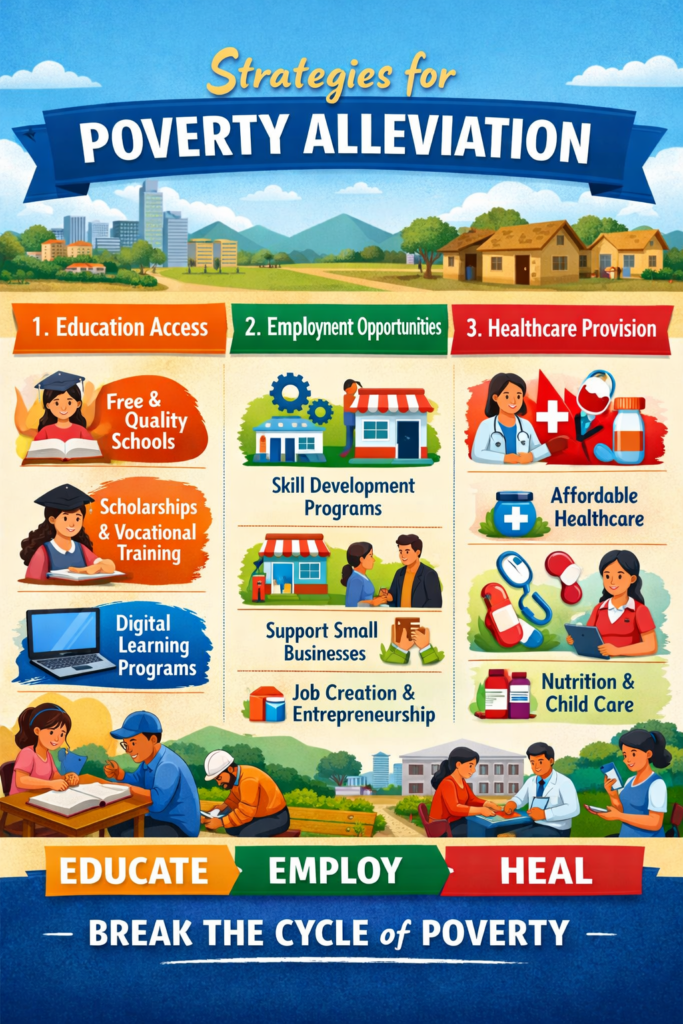
What can be strategy for Poverty Alleviation –
1) Education Access
2) Employment Opportunities
3) Healthcare Provision
1. Education Access
Education is fundamental to breaking the cycle of poverty as it enhances skills, awareness, and earning potential.
• Universal access to schooling reduces inequality and improves human capital
• Focus on reducing dropout rates, especially among girls and rural populations
• Expansion of vocational and technical education aligns skills with job markets
• Digital education helps bridge the rural-urban divide
Facts and Examples:
• India’s literacy rate is around 77%, but female literacy remains lower
• Right to Education Act guarantees free education for children aged 6–14
• Mid-Day Meal Scheme (PM POSHAN) has significantly increased school enrolment and retention
• Platforms like DIKSHA and SWAYAM provide digital learning opportunities
• Navodaya Vidyalayas offer quality education to rural students
2. Employment Opportunities
Employment generation ensures a stable source of income and reduces economic vulnerability.
• Promotion of labour-intensive sectors such as agriculture, textiles, and construction
• Skill development aligned with industry demand
• Encouragement of entrepreneurship and self-employment
• Formalization of informal jobs to provide security and benefits
Facts and Examples:
• Around 80–85% of India’s workforce is in the informal sector
• Agriculture employs nearly 45% of the workforce but contributes less than 20% to GDP
• MGNREGA guarantees 100 days of wage employment in rural areas
• Pradhan Mantri Kaushal Vikas Yojana (PMKVY) provides skill training
• Mudra Yojana offers collateral-free loans to small entrepreneurs
• Start-up India initiative promotes innovation and job creation
3. Healthcare Provision
Access to affordable healthcare is essential, as medical expenses are a major cause of poverty.
• Strengthening primary healthcare infrastructure, especially in rural areas
• Expanding health insurance coverage
• Focus on preventive healthcare, sanitation, and nutrition
• Ensuring availability of affordable medicines
Facts and Examples:
• Out-of-pocket expenditure constitutes nearly 48–50% of total health spending in India
• Rural areas face shortages of doctors and healthcare facilities
• Ayushman Bharat provides health insurance coverage up to ₹5 lakh per family
• Health and Wellness Centres improve access to primary care
• Mission Indradhanush increases immunization coverage
• Jan Aushadhi Kendras provide low-cost generic medicines