India has seen privatization of education in a big way in recent decades. What do you think has been the major fallout of this?
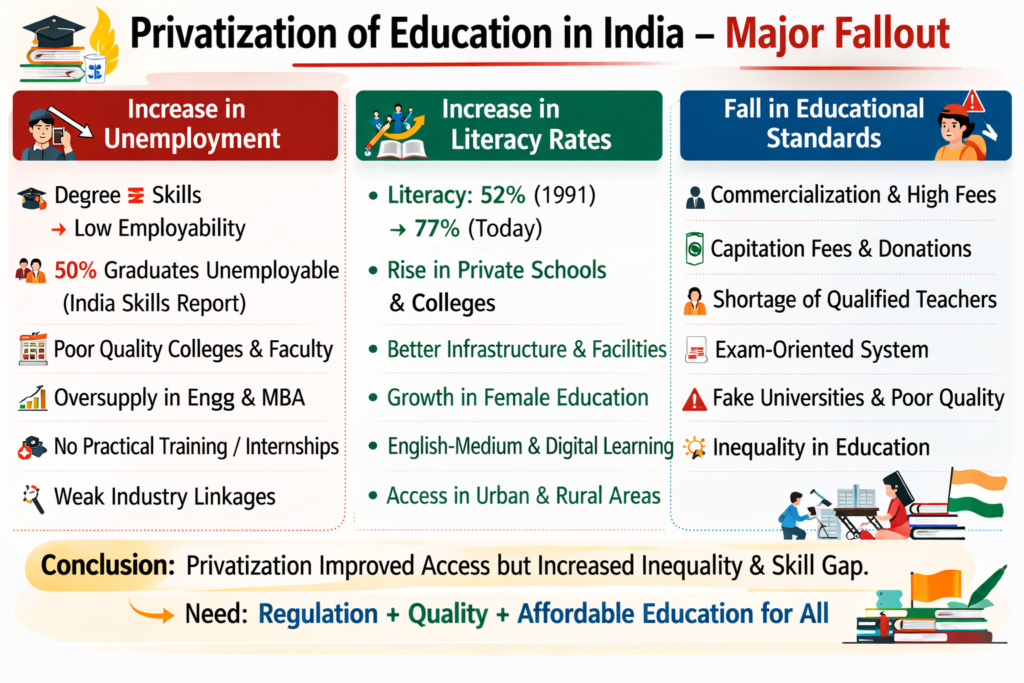
(a) Increase in unemployment
(b) Increase in literacy rates
(c) Fall in educational standards
(a) Increase in Unemployment
1. Degree-oriented system
• Many private institutions focus on providing degrees rather than practical skills, which reduces employability.
2. Low employability rate
• According to the India Skills Report, only around 45–50% of graduates in India are employable due to lack of practical skills.
3. Oversupply of certain degrees
• Rapid growth of private engineering and MBA colleges created more graduates than job opportunities.
4. Poor quality institutions
• Several private colleges operate with limited infrastructure and poorly trained faculty.
5. Placement issues
• Many private colleges have weak industry connections, so students do not get good placement opportunities.
6. Urban job competition
• Students from private colleges move to cities for jobs, increasing competition and unemployment.
7. Focus on theoretical learning
• Practical training, internships, and research are often neglected in many private institutions.
(b) Increase in Literacy Rates
1. Rapid expansion of schools
• Private schools have increased rapidly, especially in urban and semi-urban areas.
2. Improvement in literacy
• India’s literacy rate increased from 52% in 1991 to around 77%, according to the Ministry of Education.
3. Better facilities
• Private schools provide smart classrooms, better infrastructure, and smaller class sizes.
4. Improved female education
• Many private institutions have encouraged parents to educate girls, improving female literacy.
5. English-medium education
• Most private schools provide English-medium education, which attracts parents and increases enrollment.
6. Reduced burden on government schools
• Private institutions help accommodate the large population of students.
7. Education in remote areas
• Some private schools have opened in semi-rural regions where government facilities are limited.
(c) Fall in Educational Standards
1. Commercialization of education
• Education is sometimes treated as a business rather than a social service.
2. High fee structure
• Many private institutions charge high tuition fees, making education unequal and accessible mainly to wealthy families.
3. Capitation fees
• Some institutions demand donations or capitation fees for admission.
4. Focus on profit rather than quality
• Investment is often directed toward infrastructure rather than improving teaching quality.
5. Shortage of qualified teachers
• Some colleges hire underqualified or temporary faculty to reduce costs.
6. Coaching culture
• Excessive focus on exams and ranks reduces emphasis on critical thinking and creativity.
7. Fake or low-quality universities
• The University Grants Commission has identified several fake universitiesoperating without proper accreditation.
8. Inequality in education
• Students from poorer backgrounds cannot afford quality private education, widening the education gap.