1. Introduction
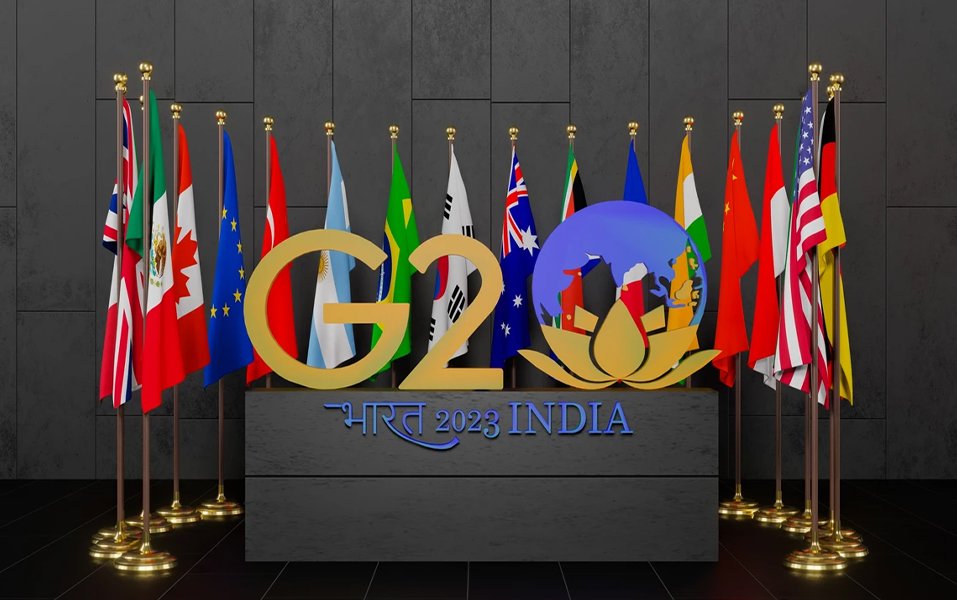
The G20, or Group of Twenty, is a forum of the world’s major advanced and emerging economies. Together, its members account for around 85% of global GDP, 75% of international trade and about 80% of the world’s population.
For India, the G20 is not merely an economic forum; it is an important platform to shape global governance, represent the interests of developing countries and project India as a responsible global power.
2. Current Scenario
India’s influence in the G20 has increased significantly, particularly after its successful G20 Presidency in 2023.
India hosted the 18th G20 Summit in New Delhi on 9–10 September 2023, culminating in the adoption of the New Delhi Leaders’ Declaration.
Some important outcomes were:
• African Union was admitted as a permanent G20 member, strengthening representation of the Global South.
• India successfully promoted the concerns of developing countries through its “Voice of the Global South” approach.
• The India-Middle East-Europe Economic Corridor (IMEC) was announced to improve connectivity and trade.
• The Global Biofuels Alliance was launched to promote sustainable energy.
• India pushed Digital Public Infrastructure, financial inclusion and technology-based development.
Even after its presidency, India has continued to push its priorities. At the 2025 G20 South Africa Summit, several Indian initiatives, including disaster-risk reduction and food-security priorities, were reflected in the Leaders’ Declaration.
3. India’s Development and Contribution
India’s role can be understood through four major areas:
First, economic leadership:
India advocates reforms in international financial institutions and greater access to finance for developing countries.
Second, Global South:
India acts as a bridge between developed economies and developing countries. The inclusion of the African Union is a major example of this approach.
Third, climate and energy:
Through initiatives such as the International Solar Alliance and Global Biofuels Alliance, India promotes affordable and sustainable energy.
Fourth, digital transformation:
India has showcased its experience with UPI, Aadhaar and other Digital Public Infrastructure as scalable models for financial inclusion and public service delivery.
Thus, India’s G20 role is gradually shifting from being a participant to an agenda-setter.
4. Challenges
However, India faces several challenges:
1. Geopolitical tensions between the US, China, Russia and other powers can make consensus difficult.
2. Developed–developing country differences remain over climate finance, trade and development priorities.
3. G20 has no legally binding enforcement mechanism, so implementation depends largely on individual countries.
4. India itself must balance economic growth with climate commitments and energy security.
5. Maintaining leadership of the Global South requires India to convert diplomatic initiatives into long-term, measurable outcomes.
5. Way Forward
India should focus on continuity rather than only presidency-driven diplomacy.
• Push for greater reform of global financial institutions.
• Strengthen cooperation with the Global South and African countries.
• Promote digital public infrastructure and affordable technology globally.
• Lead on climate-resilient infrastructure, renewable energy and green finance.
• Improve implementation of G20 commitments through measurable targets.
• Use India’s growing economic and diplomatic weight to act as a bridge between competing geopolitical blocs.