The highest result of education is tolerance.” — Helen Keller
Introduction
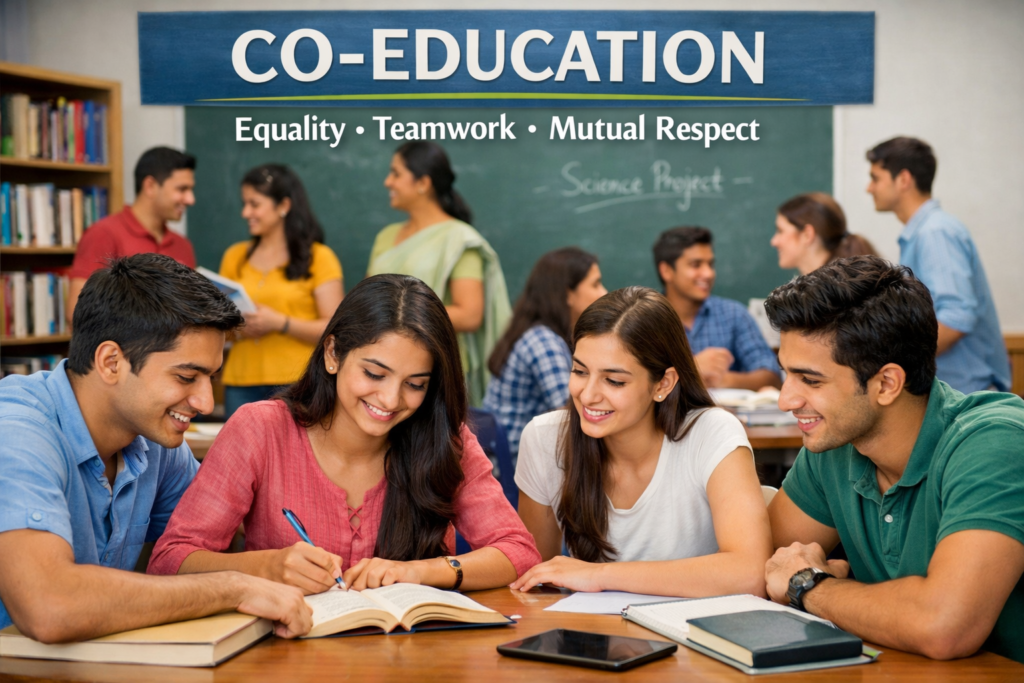
• Co-education refers to a system where male and female students are educated together in the same institution, sharing equal opportunities.
• It is a reflection of a progressive society that believes in gender equality and inclusiveness.
• It plays a crucial role in shaping attitudes, behaviour, and social understanding from an early age.
• In today’s interconnected world, men and women work together in every field, making co-education practically essential.
• It helps in developing balanced personalities by promoting interaction, cooperation, and mutual respect.
• Historically, India moved from a largely segregated education system to co-education as part of modernization and social reform.
Current Scenario
• In India, co-education is now the dominant model in higher education, professional institutions, and urban schooling systems.
• Government initiatives like Beti Bachao Beti Padhao, NEP 2020, and Right to Education have strengthened gender inclusion.
• Female literacy and enrollment rates have significantly improved, especially in urban areas.
• However, in rural and semi-urban regions, social conservatism still leads to preference for single-gender schools.
• Concerns regarding safety, infrastructure, and societal perceptions continue to influence decisions of parents.
• With increasing participation of women in armed forces, corporate sector, and governance, co-education is becoming even more relevant.
Advantages
• It promotes gender equality by providing equal opportunities and breaking historical barriers.
• Encourages healthy interaction, improving communication skills and reducing hesitation between genders.
• Helps in breaking stereotypes, such as predefined gender roles in society.
• Prepares students for real-world professional environments where teamwork between genders is essential.
• Leads to overall personality development, including confidence, leadership, and emotional intelligence.
• Creates a competitive yet balanced academic environment, benefiting both genders.
• Reduces gender bias and promotes respect, cooperation, and understanding from a young age.
Challenges
• Deep-rooted traditional mindset and patriarchal thinking still oppose co-education in many areas.
• Safety concerns, including harassment and lack of proper monitoring, affect trust in the system.
• Inadequate infrastructure like separate sanitation facilities creates practical difficulties.
• Sometimes, lack of discipline or maturity among students can lead to distractions.
• Gender bias may still exist subtly in classrooms and institutional culture.
• Social pressure and fear of judgment often restrict girls’ participation in co-educational environments.
Way Forward
• There is a need to change societal mindset through awareness campaigns and education at the grassroots level.
• Institutions must ensure strict safety measures, including surveillance, grievance redressal systems, and accountability.
• Infrastructure development, especially in rural schools, should be prioritized.
• Gender sensitization programs should be integrated into the education system.
• Teachers and parents must play a proactive role in guiding students towards respectful behaviour.
• Policies should focus on empowering girls and ensuring equal participation in all activities.
• Co-education should be promoted not just as a system, but as a tool for nation-building and social transformation.