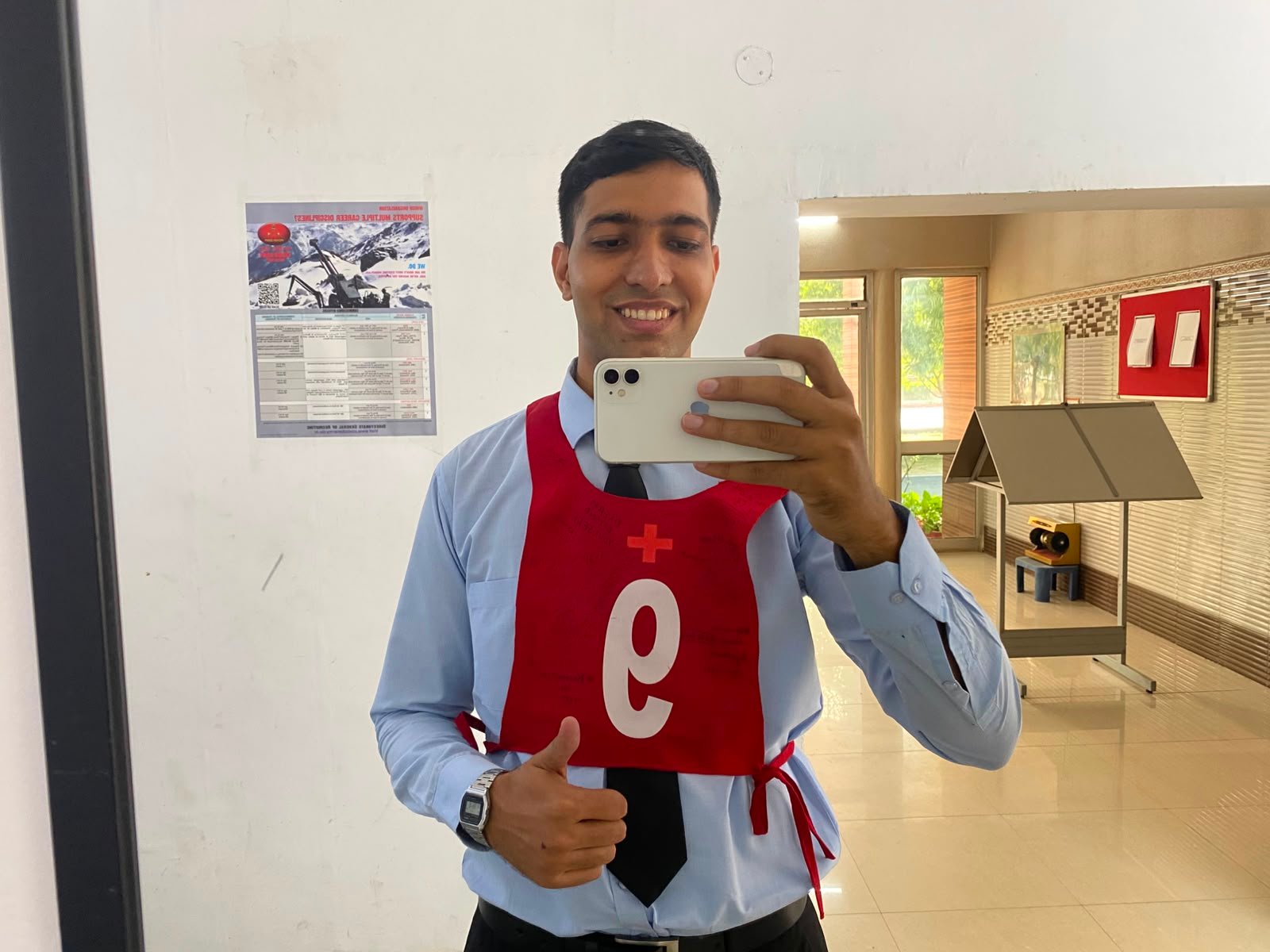
Many SSB aspirants believe that success comes from learning more techniques, solving more practice material, or finding better strategies.
For Sheenam, the breakthrough came from something much simpler:
She stopped being afraid of the SSB.
After multiple screen outs and years of chasing her dream, a shift in mindset transformed her journey and eventually led her to a recommendation through AFCAT 2 2025.
Her story is a reminder that sometimes the biggest obstacle isn’t the SSB itself—it’s the pressure we create around it.
A Dream Inspired by the Uniform
Originally from Himachal Pradesh, Sheenam completed her schooling across multiple schools due to frequent postings. She completed her senior secondary education at Viveka Foundations, Palampur, before pursuing higher education at Christ University.
The motivation to join the Armed Forces began at home.
Growing up, she regularly saw her father wearing the uniform.
For many children from defence backgrounds, the uniform becomes a symbol of pride and inspiration.
For Sheenam, it became something more.
It became a dream.
Watching her father serve inspired her to imagine herself following a similar path one day.
And over time, that dream became a goal she was determined to achieve.
The Frustration of Repeated Screen Outs
The path, however, was far from smooth.
Attempt after attempt, Sheenam found herself facing the same result.
Screened out.
Again.
And again.
And again.
In all her previous attempts, she couldn’t move beyond the screening stage.
Repeated setbacks began creating a pattern.
Not just in her results but in her mindset.
With every attempt, she became more anxious about the process.
More cautious.
More worried about making mistakes.
The SSB had slowly become something she feared rather than something she wanted to experience.
And when candidates begin carrying that fear into the assessment, it often affects their performance without them even realising it.
The Real Problem Wasn’t Preparation
Like many aspirants, Sheenam initially thought she needed more preparation.
More information.
More techniques.
More practice.
But over time, she realised the problem wasn’t necessarily a lack of knowledge.
The problem was confidence.
She was overthinking everything.
Every task felt bigger than it actually was.
Every interaction felt like a make-or-break moment.
Instead of expressing herself naturally, she was constantly worried about whether she was doing things correctly.
That pressure made the SSB seem much more intimidating than it really was.
Changing the Way She Looked at the SSB
One of the biggest turning points in her journey came when she stopped treating the SSB as something extraordinary and started viewing it as simply another examination.
That shift may sound small.
But it changed everything.
The fear reduced.
The pressure reduced.
The overthinking reduced.
Instead of trying to control every outcome, she focused on performing naturally and honestly.
For the first time, she began approaching the process with a calmer mindset.
And that calmness allowed her actual personality to come through.
Learning to Go With the Flow
When asked what was different about her successful attempt, her answer is surprisingly simple:
She relaxed.
She stopped trying to force things.
Stopped obsessing over outcomes.
Stopped putting unnecessary pressure on herself.
Instead, she trusted her preparation and allowed herself to go with the flow.
Many aspirants underestimate how powerful this can be.
The SSB is designed to observe how candidates behave naturally across different situations.
The more pressure candidates place on themselves, the harder it becomes to behave naturally.
Sheenam’s breakthrough wasn’t about becoming someone new.
It was about becoming comfortable enough to be herself.
Overcoming Her Biggest Challenge
For Sheenam, the most challenging aspect of the SSB was the GTO series.
Coming from a non-science background, she often felt disadvantaged during discussions involving technical or practical concepts.
She worried that others might possess stronger technical knowledge.
But over time, she realised something important.
The GTO isn’t a test of physics formulas or scientific expertise.
It’s a test of how candidates function within a group.
Leadership.
Cooperation.
Initiative.
Teamwork.
Communication.
These qualities matter far more than knowing every technical detail.
Once she understood this, her approach changed completely.
Instead of focusing on facts she didn’t know, she focused on working effectively with the group.
She learned how to contribute, coordinate, and build synergy with others.
And that made a significant difference in her overall performance.
The Result
After four unsuccessful attempts and multiple screen outs, Sheenam finally broke through.
Her fifth attempt ended differently.
This time, she wasn’t returning home early.
This time, she earned a recommendation through AFCAT 2 2025 at 2 AFSB Mysore.
A dream she had carried since childhood had finally become reality.
And the uniform she had admired for years was now within reach.
Her Message to Aspirants
When asked what advice she would give fellow aspirants, her response comes from personal experience:
“Always keep trying.”
Simple words.
But powerful when spoken by someone who faced repeated setbacks before succeeding.
She also shares a perspective that many candidates need to hear:
“If you worked as hard as you could and still failed, maybe that’s God’s plan. But if you didn’t give it your best shot, how would you ever know what you’re capable of?”
It’s a reminder that regret often hurts more than failure.
Failure teaches.
Failure prepares.
Failure builds resilience.
But quitting leaves questions unanswered.
A Lesson Every Aspirant Should Remember
Many candidates believe the difference between success and failure lies in intelligence, communication skills, or technical knowledge.
Sometimes it does.
But sometimes the difference is much simpler.
Sometimes the difference is confidence.
The confidence to trust yourself.
The confidence to stop overthinking.
The confidence to walk into the SSB as yourself instead of trying to become someone else.
Sheenam’s story proves that repeated setbacks don’t mean you’re not capable.
They simply mean your breakthrough hasn’t arrived yet.
And when it finally does, you’ll often realise that the person standing in your way wasn’t the assessor.
It wasn’t the process.
It was the fear you carried all along.
The moment she let go of that fear, everything changed.