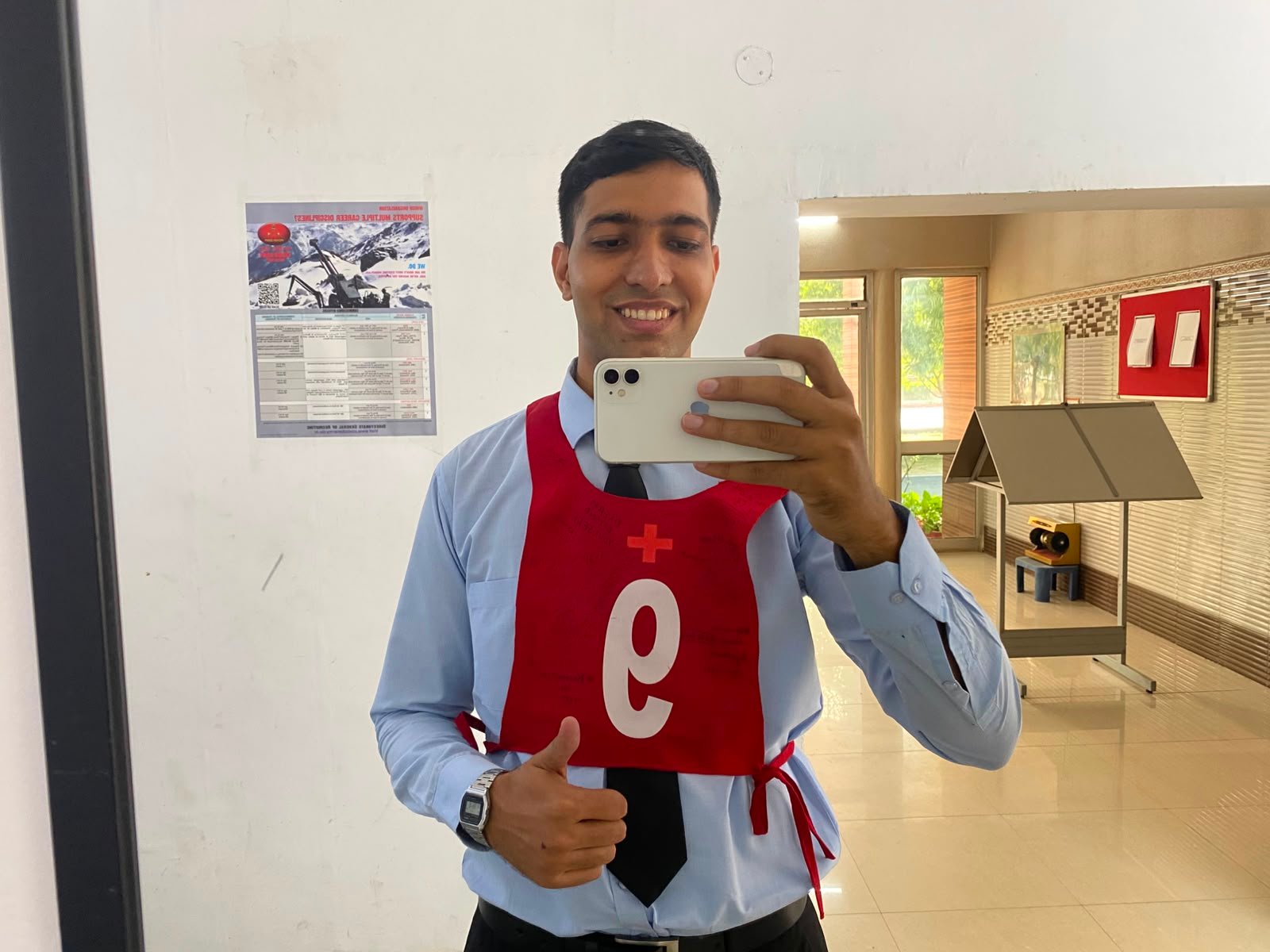
Most SSB aspirants spend years trying to earn their first recommendation.
Pratul had already achieved it.
In fact, he had done it twice.
Yet one unexpected setback taught him a lesson that many candidates learn only after multiple attempts:
Past success does not guarantee future success.
His journey is a powerful reminder that every SSB is a fresh assessment, and every candidate must continue evolving.
Chasing Adventure, Discipline, and Purpose
Pratul hails from Jaipur, Rajasthan, and is currently pursuing his studies at the Global Institute of Technology, Jaipur.
Unlike many candidates who are drawn towards the Armed Forces because of family influence, Pratul’s motivation came from something more personal.
He wanted a life that offered both adventure and discipline.
From a young age, he had always been interested in self-improvement and building discipline in his life.
The Armed Forces seemed like the perfect blend of challenge, growth, responsibility, and purpose.
What started as an attraction towards discipline gradually became a passion for the uniform.
A Strong Start
Pratul’s SSB journey began impressively.
His first attempt ended in a recommendation.
Then came the second attempt.
Another recommendation.
For many aspirants, two recommendations would seem like proof that the process had been completely figured out.
But the SSB has a way of keeping candidates humble.
The Unexpected Setback
His third attempt ended before it truly began.
He was screened out.
The result came as a surprise.
After all, this was someone who had already been recommended twice.
What had changed?
That question bothered him.
Many previously recommended candidates face a similar challenge.
The confidence that once helped them succeed can sometimes slowly transform into assumptions.
Instead of approaching each attempt with fresh awareness, candidates may unknowingly rely too heavily on past experiences.
Pratul knew something wasn’t working.
But he wasn’t entirely sure what it was.
Finding Answers in the Right Place
While looking for clarity, he came across a discussion by Shashank Sir that focused on a topic he immediately related to:
Why previously recommended candidates sometimes struggle to get recommended again.
The discussion resonated with him because it addressed exactly what he was experiencing.
For the first time, he started looking beyond individual tasks and began focusing on a more important question:
What is the Selection Board actually trying to assess?
That shift in perspective became a turning point.
Instead of preparing for activities, he started preparing to demonstrate qualities.
Instead of trying to repeat what had worked before, he started understanding why it had worked.
The difference was subtle but powerful.
Identifying the Real Issue
When reflecting on his screen-out, Pratul realised something important.
The issue wasn’t a lack of knowledge.
It wasn’t a lack of preparation.
It was his approach during group discussions.
He admits that he had become a little desperate.
Like many serious aspirants, he wanted the recommendation badly.
Unfortunately, desperation often shows itself in ways candidates don’t notice.
For him, it affected how he participated in discussions.
Instead of cooperating naturally, he became overly focused on proving himself.
And in group tasks, that can create the opposite effect.
The SSB doesn’t reward candidates who simply speak the most.
It rewards candidates who contribute effectively while helping the group move forward.
Once he understood this, he knew exactly what needed improvement.
Learning to Communicate Better
One of the biggest challenges throughout his journey was communication.
Specifically, communicative English and self-expression.
Many aspirants possess strong thoughts and good intentions but struggle to present them effectively.
Pratul recognised that communication isn’t just about speaking English fluently.
It’s about expressing ideas clearly.
It’s about ensuring people understand what you’re trying to say.
It’s about confidence, clarity, and presentation.
Over time, he worked consciously on improving these aspects.
Not to sound sophisticated.
But to communicate naturally and effectively.
And that improvement positively impacted multiple areas of the SSB process.
A Better Version of Himself
When the next attempt arrived, there wasn’t a dramatic transformation.
There was simply a more aware candidate.
A candidate who understood his previous mistake.
A candidate who had worked on communication.
A candidate who had learned to cooperate better in group discussions.
A candidate who was no longer trying to force the process.
Instead of worrying about standing out, he focused on contributing meaningfully.
And that change made all the difference.
The Result
His fourth attempt ended exactly the way he had hoped.
Recommended through TGC 143 Entry at 34 SSB.
Another recommendation added to his journey.
But perhaps more importantly, it validated the lessons he had learned after his setback.
His Message to Aspirants
When asked what advice he would give to fellow candidates, Pratul emphasised something that many aspirants underestimate:
“You need the right guidance to get onto the right path.”
He believes that preparation becomes far more effective when candidates truly understand what is being assessed.
But he also highlights something equally important:
“You need to match the energy of the position you’re working so hard for.”
It’s a powerful statement.
Because becoming an officer isn’t just about clearing an assessment.
It’s about gradually becoming someone capable of carrying that responsibility.
His advice doesn’t stop there.
He encourages aspirants to continuously work on themselves, improve their presentation, refine their communication, and keep polishing their personality.
Because success in the SSB is rarely about a single skill.
It’s usually the result of multiple small improvements coming together.
A Lesson for Every Aspirant
Pratul’s story teaches a valuable lesson:
Even recommendations don’t make you immune to setbacks.
You can be recommended twice and still get screened out.
You can perform well before and still need improvement later.
The key is how you respond when things don’t go your way.
Instead of blaming the process, Pratul reflected on his performance.
Instead of becoming frustrated, he identified the gap.
Instead of repeating the same mistakes, he corrected them.
And eventually, that correction brought him back to where he belonged.
Because sometimes success isn’t about learning something new.
Sometimes it’s about understanding what went wrong, fixing it honestly, and showing up again as a better version of yourself.