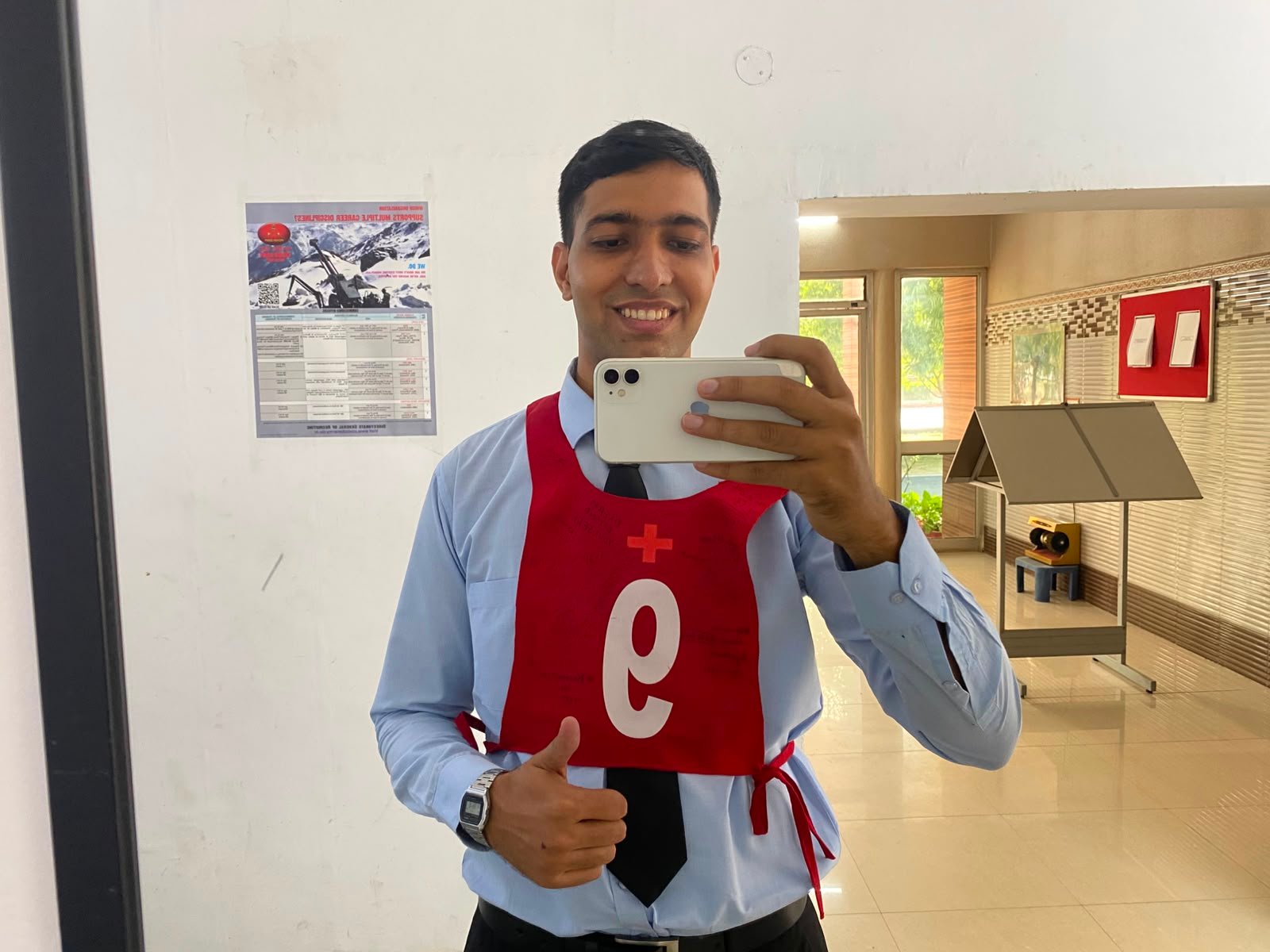
Most people see the recommendation.
They see the photograph, the congratulatory messages, and the final result.
What they don’t see are the years behind it.
The failed attempts.
The conference outs.
The screen outs.
The moments when quitting feels easier than trying again.
Abhishek knows that side of the journey better than most.
Because before earning his recommendation through AFCAT 2 2025, he spent years chasing a dream that refused to come easily.
A Dream Born Inside Cantonments
Abhishek comes from Dehradun, Uttarakhand, and completed his schooling at an Army School.
The Armed Forces were never something he observed from a distance.
They were part of his everyday life.
His father served in the Artillery, and growing up inside defence campuses and cantonment areas exposed him to a lifestyle that many people only see occasionally.
But there was one experience that made a particularly strong impact.
In Class 9, he visited the Indian Naval Academy and also got an opportunity to witness his father’s unit closely.
The experience left him fascinated.
The discipline.
The environment.
The sense of pride and belonging.
For the first time, he could clearly imagine where he wanted to be in the future.
And from that point onward, joining the Armed Forces became more than a dream—it became a goal.
Years of Attempts
The journey began in 2019.
Like many defence aspirants, Abhishek started with NDA entries.
He appeared for three NDA SSBs.
All three ended in conference outs.
After graduating from engineering in 2024, he continued pursuing his goal through CDS and AFCAT entries.
Five CDS attempts.
Three AFCAT attempts.
Along with the NDA attempts and other entries, the number eventually climbed to around 14 attempts.
Out of those, he was screened out only twice.
Twelve times, he successfully cleared screening and progressed further.
At first glance, that sounds encouraging.
But repeated progress without a final recommendation can become mentally exhausting.
Every conference creates hope.
Every result creates questions.
And over time, the emotional weight starts accumulating.
The Pain of Being So Close
Ironically, one of the toughest setbacks for Abhishek wasn’t a conference out.
It was being screened out.
Because he knew he was capable of performing well once he entered the assessment process.
Getting eliminated on Day 1 felt particularly frustrating.
He wasn’t looking for shortcuts.
He wasn’t looking for luck.
He simply felt that he needed the right guidance to identify what was going wrong.
The challenge was that he couldn’t clearly see his own mistakes.
And when you don’t know what’s causing the problem, improving becomes extremely difficult.
Discovering What Was Missing
Abhishek eventually came across guidance through a friend.
What followed wasn’t a dramatic overnight transformation.
Instead, it was a gradual process of identifying and correcting small but important mistakes.
For the first time, he began understanding why certain things weren’t working.
The practice sessions helped him recognise patterns in his performance that had previously gone unnoticed.
One area that particularly helped him was communication.
Small details such as voice modulation, body language, and micro-actions started receiving focused attention.
These weren’t major changes.
But in the SSB, small improvements often create significant differences.
The next time he appeared, he successfully cleared screening again.
But more importantly, he carried a better understanding of himself into the process.
The Problem with Overpreparation
One of the most interesting lessons from Abhishek’s journey is that sometimes candidates prepare too much in the wrong way.
For years, he believed that more information meant better preparation.
He memorised content.
Collected material.
Tried to fit ideal responses into different situations.
But over time, he realised something important:
He was remembering answers without truly understanding them.
This became particularly evident during Psychology tests.
His stories often followed repetitive patterns.
The structure remained the same.
The themes remained the same.
The originality disappeared.
Instead of reflecting his personality, many responses felt mechanical.
The preparation was extensive.
The authenticity was missing.
Learning to Trust His Own Thinking
This attempt was different because he stopped trying to sound perfect.
Instead of reproducing prepared ideas, he started relying on his own thoughts and experiences.
His Psychology responses became more natural.
More personal.
More realistic.
The change wasn’t about writing better stories.
It was about writing his stories.
And that distinction mattered.
Improving Group Performance
Another important shift came during group tasks.
Previously, Abhishek had a tendency to overexpress himself.
Like many serious aspirants, he believed that speaking more would automatically create a stronger impression.
But excessive participation can sometimes work against a candidate.
This time, he approached group activities differently.
He focused on coordination rather than domination.
Listening became just as important as speaking.
The goal was no longer to stand apart from the group.
The goal was to contribute effectively to it.
That balance improved his overall performance significantly.
The Result
After years of preparation, setbacks, conference outs, screen outs, and self-correction, the outcome finally arrived.
Recommended through AFCAT 2 2025.
A recommendation that represented far more than a single SSB result.
It represented persistence.
Growth.
Adaptability.
And the willingness to keep improving despite repeated disappointments.
His Message to Aspirants
When asked what advice he would give fellow candidates, his answer came from personal experience:
“Don’t give up.”
Simple words.
But words that carry weight when spoken by someone who appeared for 14 attempts.
He understands better than most what it feels like to wait for a result that doesn’t arrive.
To return home after another conference out.
To wonder whether the next attempt will be different.
Yet he continued showing up.
And eventually, the result changed.
He adds another important reminder:
“Don’t let doubts enter your mind. Keep preparing and keep believing in yourself.”
Because in a journey as long and demanding as the SSB, self-doubt often becomes a bigger obstacle than the assessment itself.
What Can Aspirants Learn From His Story?
Abhishek’s journey teaches a lesson that many candidates overlook.
More preparation doesn’t always mean better preparation.
Sometimes improvement comes from understanding rather than memorising.
From expressing yourself rather than performing a role.
From being authentic rather than ideal.
And perhaps most importantly, from refusing to quit after setbacks.
Because the truth is, if Abhishek had stopped after the third attempt, the sixth attempt, or even the tenth attempt, this story would have ended very differently.
Instead, he kept moving forward.
And after 14 attempts, he finally reached the destination he had been chasing since Class 9.
A reminder that persistence doesn’t guarantee success immediately.
But giving up guarantees that success will never arrive.