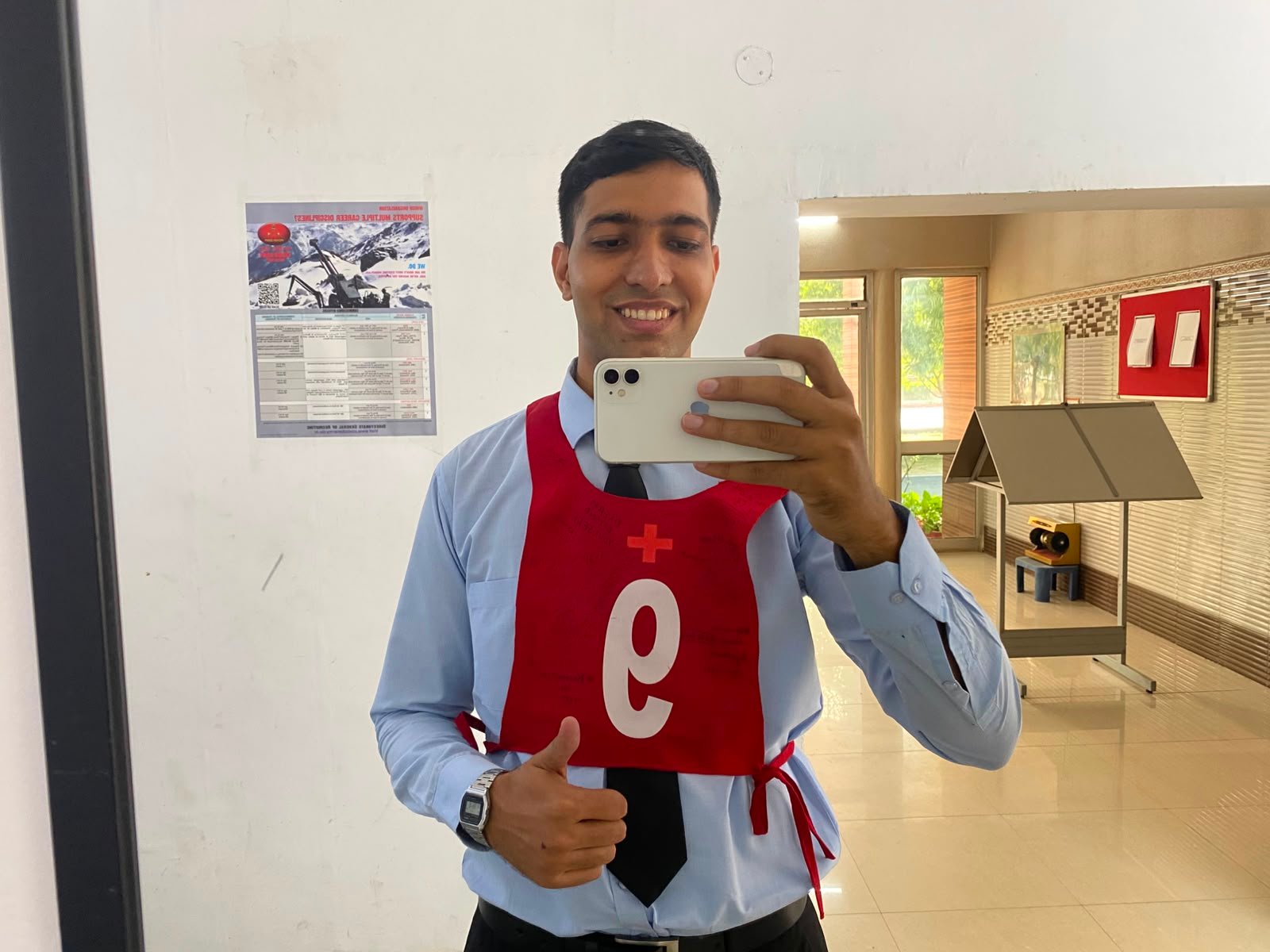
Every SSB aspirant remembers the setbacks.
The screen outs.
The conference outs.
The difficult questions.
But sometimes, the toughest challenge isn’t a task, an interview, or a psychological test.
Sometimes, it’s believing in yourself after someone points out your shortcomings.
For Shubham, one such moment nearly shook his confidence. Looking back today, however, he believes it became one of the most important turning points in his journey.
Growing Up With the Uniform Around Him
Shubham comes from Bhagalpur, Bihar, a place where service in the Armed Forces is deeply respected.
As he describes it, almost every household in his area has someone serving or who has served in the military. Growing up in such an environment naturally made the uniform familiar and inspiring.
He completed his Class 10 from DAV Public School, Bhagalpur, and later pursued his Class 12 in Jharkhand. He is currently in the final year of his B.Tech at Lovely Professional University (LPU), Punjab.
While the dream of joining the Armed Forces was always present, it became much stronger after he joined NCC during college.
Interacting with officers, participating in activities, and experiencing military culture more closely transformed curiosity into commitment.
The goal was now clear.
The Challenge That Kept Holding Him Back
Many aspirants struggle with interviews.
Some struggle with GTO tasks.
For Shubham, the biggest obstacle was Psychology.
Across his previous attempts, he often felt dissatisfied with his psychological performance. His stories lacked depth, originality, and personal connection.
Instead of reflecting his real personality, many responses felt generic and incomplete.
As a result, he would walk out of the testing hall knowing he hadn’t truly represented himself.
And until that problem was solved, recommendations remained out of reach.
Understanding What Psychology Tests Actually Demand
After joining the R2R Psychology batch, Shubham began receiving structured guidance from mentors including Sushant Sir and Neha Ma’am.
The biggest realization wasn’t about learning a new format.
It was understanding what the assessors were actually looking for.
He learnt that psychology tests aren’t about creating ideal heroes or writing impressive stories.
They’re about revealing your thought process.
Gradually, his responses started changing.
His stories became more personal.
More realistic.
More complete.
Most importantly, they began reflecting his own life experiences rather than generic situations.
For the first time, he felt satisfied with his psychological performance.
The practice sets provided during preparation also played a significant role. In fact, one of the questions he encountered during his actual SSB was remarkably similar to something he had already attempted during practice, allowing him to approach it with confidence.
What had once been his biggest weakness slowly started becoming one of his strengths.
The Interview Lesson That Changed His Perspective
Alongside Psychology, interviews had also been a challenge.
In earlier attempts, Shubham often focused on answering questions without fully understanding what the interviewer was actually trying to assess.
Like many aspirants, he would answer the question that he heard, not necessarily the question that was being evaluated.
Through mock interviews and feedback sessions, he gradually learnt how to understand the intent behind the questions and respond accordingly.
One particular incident stayed with him.
During a mock interview, he was asked to rate his own performance at the end of the session.
He gave himself a 6.5 out of 10.
The interviewer responded by saying that even 6.5 was too generous.
The comment hit hard.
For a moment, it made him question his preparation and his chances of success.
But instead of letting that moment define him, he chose to learn from it.
The mentors at R2R reached out, motivated him, and helped him view the feedback for what it truly was: an opportunity to improve, not a verdict on his capability.
That support helped him regain focus and continue working on himself.
What Changed in the Successful Attempt?
Shubham’s recommendation through CDS IMA 2025 wasn’t the result of one dramatic change.
It was the culmination of many smaller improvements.
This time:
- His psychology stories revolved around his own experiences.
- His responses were complete and meaningful.
- His SRT performance improved significantly.
- He understood the intent behind interview questions.
- He approached the assessment with greater clarity and confidence.
The difference was visible not only to him, but also in the outcome.
After four attempts, recommendation finally arrived.
Overcoming Weaknesses Beyond Psychology
Interestingly, Psychology wasn’t the only challenge Shubham faced.
He openly admits that General Knowledge and Current Affairs were never his strongest areas.
This often worried him before group discussions.
However, instead of panicking when unfamiliar topics appeared, he relied on his presence of mind, logical thinking, and ability to contribute constructively to discussions.
His experience reinforced an important lesson:
No candidate is perfect.
The key is knowing how to leverage your strengths while continuously working on your weaknesses.
His Message to Aspirants
“Never stop working on yourself. Keep introspecting your life regularly. The more you understand yourself, the better you’ll perform in SSB.”
He also believes that the right guidance can help candidates identify and overcome obstacles much faster than they would on their own.
The Takeaway
One of the most interesting aspects of Shubham’s journey is that his breakthrough didn’t come from learning how to impress assessors.
It came from learning how to understand himself better.
The moment his stories became personal.
The moment his answers became authentic.
The moment he stopped writing what sounded good and started expressing what was true.
Everything began to change.
His story is a reminder that preparation is not just about improving performance. It’s about improving self-awareness.
And sometimes, the recommendation follows naturally when those two begin to align.